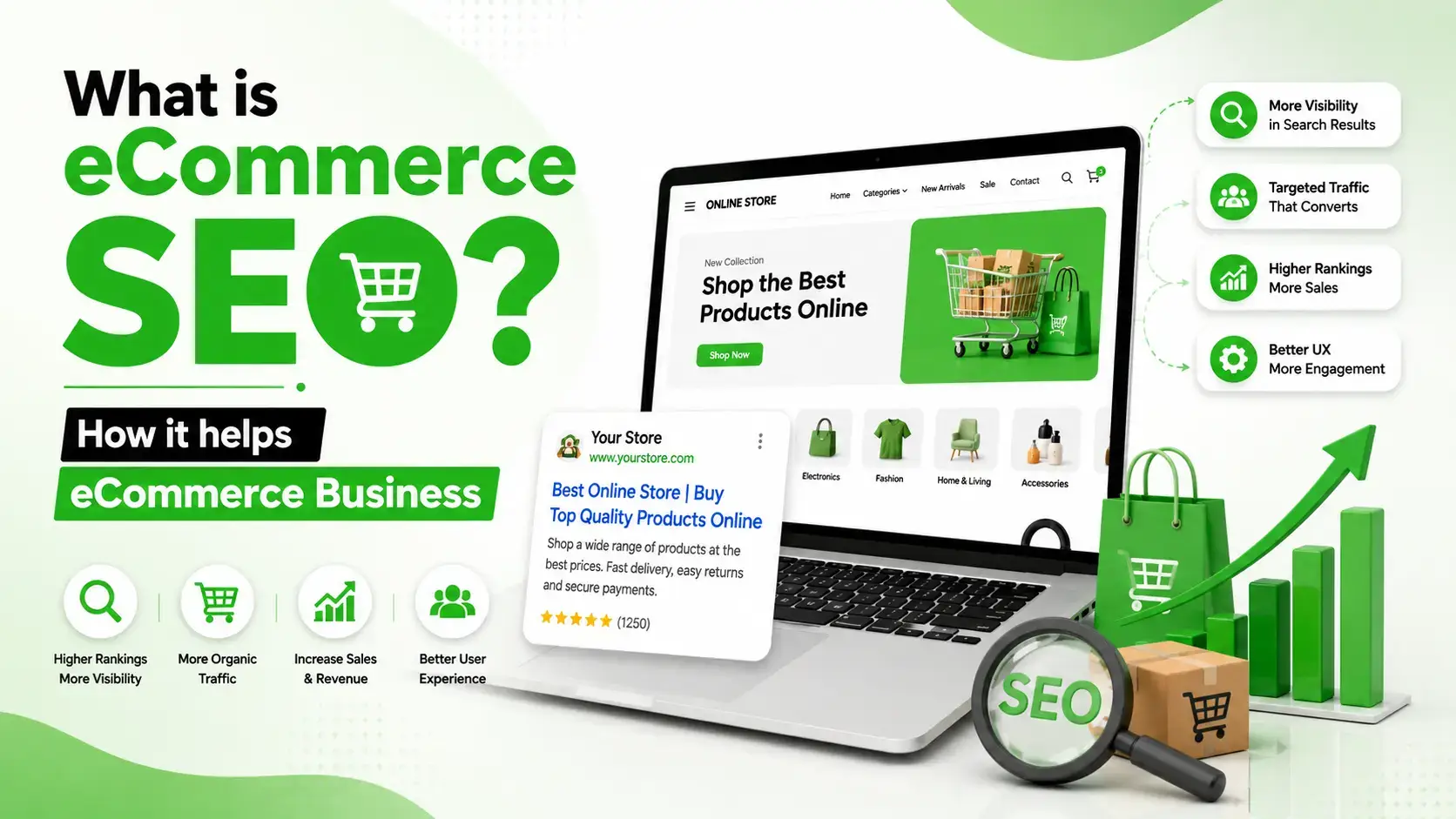
What is eCommerce SEO?
eCommerce SEO is the process of optimizing your online store so that it ranks higher in search engine results pages (SERPs) — helping more potential buyers discover your products organically, without paying for ads.
When a shopper types “buy leather wallet online” or “affordable running shoes in Bangladesh” into Google, the stores that appear at the top didn’t get there by luck. They got there through a well-executed eCommerce SEO strategy — one that signals to Google that their pages are the most relevant, trustworthy, and helpful results for that search.
eCommerce SEO covers every part of your online store:
- Your homepage and brand positioning
- Category pages that organize your products
- Individual product pages where purchase decisions happen
- Blog content that attracts buyers earlier in their journey
- The technical foundation that allows Google to crawl and index your site
When all of these elements are optimized together, the result is consistent, compounding organic traffic — and more sales.
eCommerce SEO vs. Regular SEO: What’s Different?
Traditional SEO and eCommerce SEO share the same core principles — relevance, authority, and user experience. But eCommerce SEO comes with its own unique challenges:
- Large product catalogs mean hundreds or thousands of pages that all need optimization
- Duplicate content is extremely common when similar products share descriptions
- Thin content on product pages is one of the most common eCommerce SEO mistakes
- Crawl budget management becomes critical for stores with thousands of pages
- Structured data (schema markup) for products — showing prices, ratings, and availability directly in Google results — is essential for eCommerce but less critical for service websites
Understanding these differences is why eCommerce SEO requires a specialized approach rather than a one-size-fits-all strategy.
Key Components of eCommerce SEO
1. Keyword Research for Products and Categories
Everything in eCommerce SEO starts with understanding what your customers are searching for. Effective keyword research means identifying:
- High-intent buying keywords — phrases like “buy,” “price,” “best,” “affordable,” or “online” paired with your product type
- Long-tail keywords — more specific phrases like “waterproof hiking boots under 3000 taka” that attract highly motivated buyers
- Category-level keywords — broader terms that match your product collections
- Informational keywords — questions and how-to topics your target buyers search before making a purchase
Mapping the right keywords to the right pages ensures every part of your store is pulling in relevant traffic.
2. On-Page Optimization for Product Pages
Your product pages are your most important conversion real estate — and they need to be optimized for both search engines and shoppers.
Strong product page SEO includes:
- Unique, keyword-rich product titles that match how buyers search
- Original product descriptions — not copy-pasted from manufacturer specs (Google penalizes duplicate content)
- Optimized meta titles and descriptions that encourage clicks from search results
- Image alt text describing the product with relevant keywords
- Clear URL structures like
/shop/mens-leather-wallets/rather than/product?id=3847 - Customer reviews — they add fresh, unique content to your page automatically
One of the biggest missed opportunities in eCommerce is product pages with thin, generic descriptions. A detailed, well-written product page doesn’t just rank better — it sells better too.
3. Category Page Optimization
Category pages are some of the highest-value pages on any eCommerce site. They target broader, high-volume keywords and funnel buyers into specific product areas.
Yet most online stores treat category pages as nothing more than a grid of product thumbnails. A properly optimized category page includes:
- A keyword-targeted H1 heading
- A short introductory paragraph naturally using primary and secondary keywords
- Internal links to related categories and top products
- Filters and sorting options that don’t create duplicate URL problems
Getting category page SEO right can drive massive amounts of qualified traffic that converts directly into sales.
4. Technical SEO for eCommerce
Technical SEO is the foundation everything else is built on. Without it, even the best content won’t rank. For eCommerce stores, technical SEO priorities include:
- Site speed — Slow-loading stores lose both rankings and customers. Google’s Core Web Vitals directly impact where you rank.
- Mobile optimization — The majority of online shoppers browse on smartphones. A seamless mobile experience is essential.
- Crawlability and indexation — Search engines need to be able to access, crawl, and index your pages. Broken links, redirect chains, and orphaned pages all damage this.
- Canonical tags — Used to prevent duplicate content issues caused by product variants, filters, or sorting options
- XML sitemaps — Help Google discover and prioritize your most important pages
- Structured data markup — Enables rich results showing product prices, stock availability, and star ratings directly in Google search — dramatically improving click-through rates
5. Content Marketing for eCommerce
Buyers don’t always go straight to Google and type “buy [product].” Many of them start with questions:
- “What’s the best laptop for students?”
- “How do I choose the right running shoe?”
- “Is leather or canvas better for a backpack?”
A blog that answers these questions positions your store as an authority — and captures potential buyers early in their decision-making process. By the time they’re ready to purchase, they already trust your brand.
A well-planned eCommerce content strategy also generates backlinks naturally, which boosts your domain authority and helps all your product pages rank higher over time.
6. Link Building for eCommerce
Backlinks — links from other websites pointing to yours — remain one of Google’s strongest ranking signals. For eCommerce stores, effective link building strategies include:
- Getting featured in “best of” and product roundup articles
- Reaching out to bloggers and influencers in your niche for product reviews
- Building relationships with industry publications and news sites
- Creating genuinely useful content (like guides, comparisons, or tools) that earns links naturally
- Listing your store in trusted business and eCommerce directories
The more high-quality websites link to your store, the more authority you build — and the higher your pages climb in Google’s rankings.
How eCommerce SEO Helps Your Online Business Grow
Now let’s talk about the impact. What does a well-executed eCommerce SEO strategy actually do for your business?
Drives Consistent Organic Traffic — Without Paying Per Click
Paid ads work, but they stop the moment you stop spending. eCommerce SEO builds a sustainable traffic engine. Once your pages rank, they can bring in buyers day and night — without an ongoing ad spend eating into your margins.
Attracts High-Intent Shoppers Ready to Buy
Organic search is uniquely powerful because it connects you with people who are already looking for what you sell. Someone searching “buy men’s formal shoes online Bangladesh” is not casually browsing — they’re ready to purchase. SEO puts your store directly in front of buyers at that critical moment.
Reduces Customer Acquisition Costs Over Time
As your organic rankings grow, your cost per acquisition drops significantly compared to running paid ads indefinitely. The ROI from SEO compounds over time, making it one of the most cost-effective growth channels available to eCommerce businesses.
Builds Brand Authority and Trust
Consistently appearing at the top of Google for your product categories makes your brand synonymous with those products in customers’ minds. Strong rankings, positive reviews, and a polished website all combine to build the kind of trust that drives both first-time purchases and repeat business.
Gives You a Competitive Edge
Your competitors are investing in SEO. The question is whether you’re going to let them own the top spots — or compete for them. A smart eCommerce SEO strategy lets even smaller stores consistently outrank bigger, better-funded competitors by being more targeted and more relevant.
Improves the Overall Shopping Experience
Good eCommerce SEO and good user experience go hand in hand. Faster page loads, clearer navigation, better product descriptions, and mobile-friendly design all improve your SEO rankings — and they also make shopping on your site more enjoyable, increasing conversions and reducing bounce rates.
Common eCommerce SEO Mistakes to Avoid
Even well-intentioned store owners often make these costly mistakes:
- Copying manufacturer product descriptions — This creates duplicate content that Google ignores or penalizes
- Ignoring category pages — Treating them as pure navigation rather than SEO opportunities
- Thin product pages — Pages with just a photo, a price, and three lines of text won’t rank
- No internal linking strategy — Failing to connect related products and categories properly
- Blocking important pages with robots.txt — Accidentally preventing Google from indexing key pages
- Neglecting page speed — Especially on mobile, where most shoppers browse
Avoiding these mistakes alone can put your store significantly ahead of competitors who are making them every day.
Do You Need an eCommerce SEO Expert?
eCommerce SEO is one of the most technical and time-intensive forms of digital marketing. Between managing your catalog, handling customer service, processing orders, and running daily operations — finding the time to execute a proper SEO strategy is a serious challenge for most store owners.
That’s where professional expertise makes a measurable difference. Working with a skilled SEO Expert in Bangladesh means your store gets a comprehensive, data-driven strategy — from technical site audits and keyword mapping to content development and link building — all executed with precision and consistency.
And if your eCommerce business also has a physical presence or serves customers in specific regions, combining eCommerce SEO with the expertise of a Local SEO Expert in Bangladesh gives you a powerful dual advantage — ranking both for online product searches and local buyer intent searches simultaneously.
Final Thoughts
eCommerce is one of the most competitive environments on the internet — but it’s also one of the most rewarding for businesses that master SEO. Every day that your store ranks higher in Google is another day of organic traffic, new customers, and sales that don’t require a paid ad budget. eCommerce SEO isn’t an expense — it’s an investment that pays dividends for years. If you’re serious about growing your online store, the time to invest in eCommerce SEO is now — before your competitors lock up the top positions and make it even harder to compete. Your customers are searching. Make sure they find you. Want to grow your eCommerce store with proven SEO strategies? Work with an experienced SEO Expert in Bangladesh and start turning organic search into your most powerful sales channel.