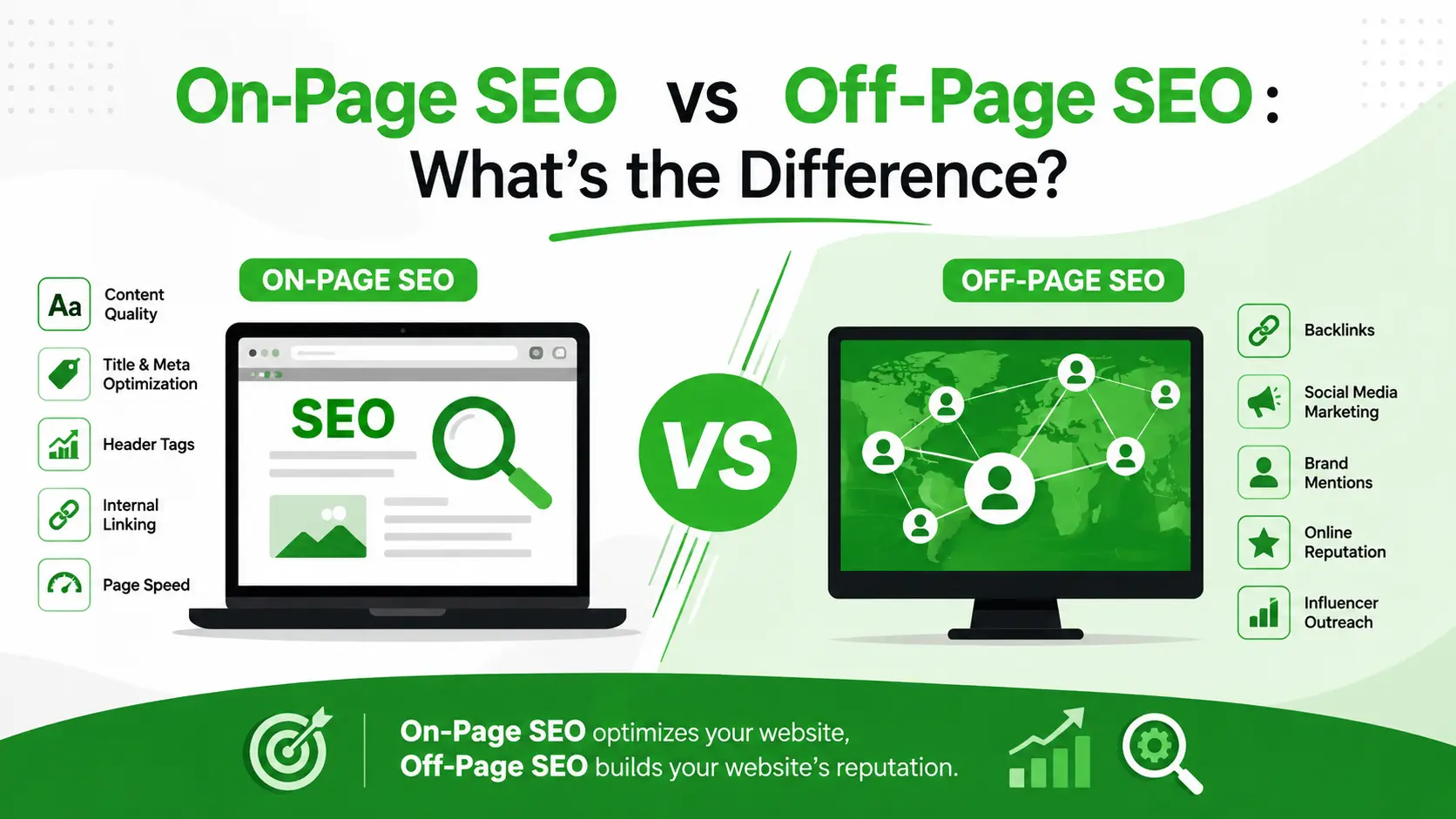
SEO involves several different strategies, but two of the most important are on-page SEO and off-page SEO. Although both aim to improve a website’s visibility in search engines, they work in different ways. On-page SEO focuses on optimizing elements directly on your website, such as content, headings, title tags, URLs, internal links, images, and search intent. Off-page SEO focuses on activities outside your website, including earning relevant backlinks, building brand mentions, managing local citations, and developing online authority.
Understanding the difference between these two areas can help business owners make better SEO decisions and avoid spending time or money on strategies that do not match their needs. In this guide, we’ll explain how on-page and off-page SEO work, how they differ, and why businesses should use both as part of a sustainable SEO strategy.
What Is On-Page SEO?
On-page SEO, also known as on-site SEO, is the process of improving individual pages and website elements to make them more useful for visitors and easier for search engines to understand. On-page SEO includes both content and technical elements. Some important examples include:
- Keyword research and search intent
- Title tags
- Meta descriptions
- Headings
- Website content
- Internal linking
- URL structure
- Image optimization
- Mobile usability
- Page experience
- Relevant structured data
The goal isn’t to repeat a keyword as many times as possible. Instead, the page should clearly answer the searcher’s question and provide useful information.
For example, if someone searches for “local SEO expert in Bangladesh,” a relevant service page should explain the SEO services offered, who they are suitable for, the approach used, relevant experience, and how the potential client can get started.
This creates a better experience than simply repeating the target keyword throughout the page. If you are new to SEO, you can learn the fundamentals from our existing guide: What Is SEO?
Important On-Page SEO Factors
1. Search Intent
Before creating a page, understand what the searcher actually wants. Someone searching “what is SEO” wants educational information, while someone searching “SEO expert in Bangladesh“ may be looking for a professional service.
Matching the content with search intent makes the page more relevant and useful.
2. High-Quality Content
Your content should answer questions clearly, provide practical information, and avoid unnecessary repetition.
Useful content should be:
- Relevant
- Accurate
- Easy to understand
- Well structured
- Written for people first
- Supported by reliable information where necessary
3. Title Tags and Headings
A clear title tells both users and search engines what the page is about. Headings then organize the information into logical sections. Avoid creating titles that contain multiple keywords simply for SEO purposes.
4. Internal Links
Internal links connect related pages on your website. For example, this article can link to your existing What Is Local SEO? guide when discussing local search. Internal linking helps visitors discover related information and creates a logical structure between your content.
5. URL and Image Optimization
Use short, descriptive URLs and optimize images with appropriate file names and useful alt text. These small improvements contribute to a cleaner and more accessible website.
What Is Off-Page SEO?
Off-page SEO refers to activities that happen outside your website and can help build your website’s authority, reputation, and visibility. The most commonly discussed part of off-page SEO is link building, but off-page SEO involves more than backlinks.
Examples include:
- Relevant backlinks
- Brand mentions
- Digital PR
- Local citations
- Business partnerships
- Industry publications
- Genuine customer reviews
- Professional relationships
- Relevant community participation
The objective should not be to collect as many links as possible.
Instead, focus on earning relevant and trustworthy references from websites, organizations, and people that have a genuine connection to your industry. For example, a relevant editorial mention from a respected business publication can be more meaningful than hundreds of unrelated links from low-quality websites.
Important Off-Page SEO Factors
1. Backlinks
A backlink is a link from another website to your website. Relevant backlinks can help search engines discover relationships between websites and understand the wider authority of a site. However, quality matters more than simply increasing the number of links.
Avoid:
- Buying large quantities of low-quality links
- Automated link-building schemes
- Irrelevant directories
- Excessive exact-match anchor text
- Spammy websites
2. Brand Mentions
When other websites, publications, businesses, or organizations mention your brand, it can help increase awareness and establish a broader online presence. Building a recognizable brand can also create more opportunities for genuine links and referrals.
3. Local Citations
Local citations are references to a business’s information on external websites and directories. For local businesses, accurate business information across relevant platforms can support a consistent online presence.
4. Reviews and Reputation
Genuine customer reviews can influence how potential customers perceive a business. Businesses should encourage authentic feedback and respond professionally to both positive and negative reviews. Never create fake reviews or testimonials.
On-Page SEO vs Off-Page SEO: Key Differences
| On-Page SEO | Off-Page SEO |
|---|---|
| Happens on your website | Happens outside your website |
| Focuses on content and page optimization | Focuses on authority and reputation |
| Includes internal links | Includes external backlinks |
| Involves titles and headings | Involves brand mentions |
| Optimizes URLs and images | Includes local citations |
| Improves search intent alignment | Includes digital PR |
| You have greater control | Depends on external websites and people |
The easiest way to remember the difference is:
On-page SEO improves your website.
Off-page SEO builds your website’s reputation beyond your website.
Which Is More Important: On-Page or Off-Page SEO?
Neither should be considered universally more important.
A website needs a strong foundation before it can benefit fully from external authority.
Imagine a website with hundreds of backlinks but poor content, confusing navigation, slow pages, and unclear services. More backlinks won’t automatically fix those problems.
On the other hand, a website may have excellent content but struggle to compete in a highly competitive search result without enough external recognition.
That’s why a balanced SEO strategy is generally more effective.
A practical approach is:
Technical foundation → On-page optimization → Useful content → Internal linking → Authority building → Measurement and improvement
On-Page and Off-Page SEO for Local Businesses
Local businesses need both strategies. For example, a business targeting customers in Bangladesh may optimize its website with:
- Location-specific service pages
- Relevant local keywords
- Clear business information
- Helpful local content
- Internal links
- Mobile-friendly pages
Off-page and local SEO activities can include:
- Google Business Profile optimization
- Genuine customer reviews
- Local citations
- Relevant local backlinks
- Local business relationships
- Community involvement
If you’re interested in the fundamentals of local search, read What is Local SEO?.
On-Page and Off-Page SEO for eCommerce Websites
eCommerce websites also need a combination of both strategies. On-page optimization can include:
- Product titles
- Product descriptions
- Category pages
- Internal links
- Product images
- Search intent
- Structured data
- Customer reviews
Off-page SEO may include relevant product reviews, industry publications, brand mentions, Digital PR, and relevant backlinks.
For a broader introduction, Read What is eCommerce SEO?.
Common SEO Mistakes to Avoid
Some common mistakes can limit the effectiveness of an SEO campaign.
Keyword Stuffing
Repeating the same keyword unnaturally can make content difficult to read.
Buying Cheap Backlinks
Large quantities of low-quality links may provide little value and can create unnecessary risk.
Ignoring Search Intent
A page may target the right keyword but still fail to satisfy what the searcher actually wants.
Creating Thin Content
Publishing short pages with little useful information simply to target keywords rarely creates a strong resource.
Ignoring Internal Linking
Related pages should be connected where it genuinely helps the reader.
Focusing Only on Rankings
SEO should ultimately support meaningful outcomes such as qualified traffic, leads, inquiries, and sales.
How to Build a Balanced SEO Strategy
A practical SEO campaign can follow these steps:
1. Understand your audience: Identify your customers, services, locations, and business goals.
2. Perform an SEO audit: Check technical issues, content quality, indexing, website structure, and existing visibility.
3. Research keywords: Group keywords according to search intent and business relevance.
4. Optimize important pages: Improve titles, content, headings, internal links, URLs, and user experience.
5. Publish useful content: Create articles that answer genuine customer questions.
6. Build authority: Earn relevant backlinks, mentions, citations, and relationships.
7. Measure performance: Track organic traffic, search impressions, clicks, leads, and conversions.
8. Improve continuously: SEO requires ongoing analysis because search results, competitors, and customer behavior change.
Final Thoughts
On-page SEO and off-page SEO are not competing strategies. They are two important parts of a complete SEO campaign. On-page SEO makes your website relevant, useful, structured, and easier to understand. Off-page SEO helps establish authority, reputation, and visibility beyond your website. If you want sustainable results, don’t focus only on keywords or backlinks. Build a website that genuinely helps your audience, create content that answers real questions, maintain a strong technical foundation, and develop legitimate relationships across your industry.
For businesses looking for the Best SEO Expert in Bangladesh, it’s important to choose an SEO professional who focuses on practical strategy rather than unrealistic ranking promises. SEO results depend on competition, website condition, search demand, industry, content quality, and many other factors.
Md Tanvir Hussain focuses on SEO strategies including Local SEO, eCommerce SEO, website optimization, and organic search growth. The right strategy should always begin with understanding the business, its customers, competitors, and current website performance.
If your goal is to improve local visibility, you can explore Local SEO in more detail through the existing guide on this website. If you operate an online store, the eCommerce SEO guide provides a useful starting point for understanding search optimization for online businesses. A strong SEO strategy doesn’t rely on one technique. It combines useful content, technical foundations, on-page optimization, internal linking, and genuine external authority to create long-term search visibility.