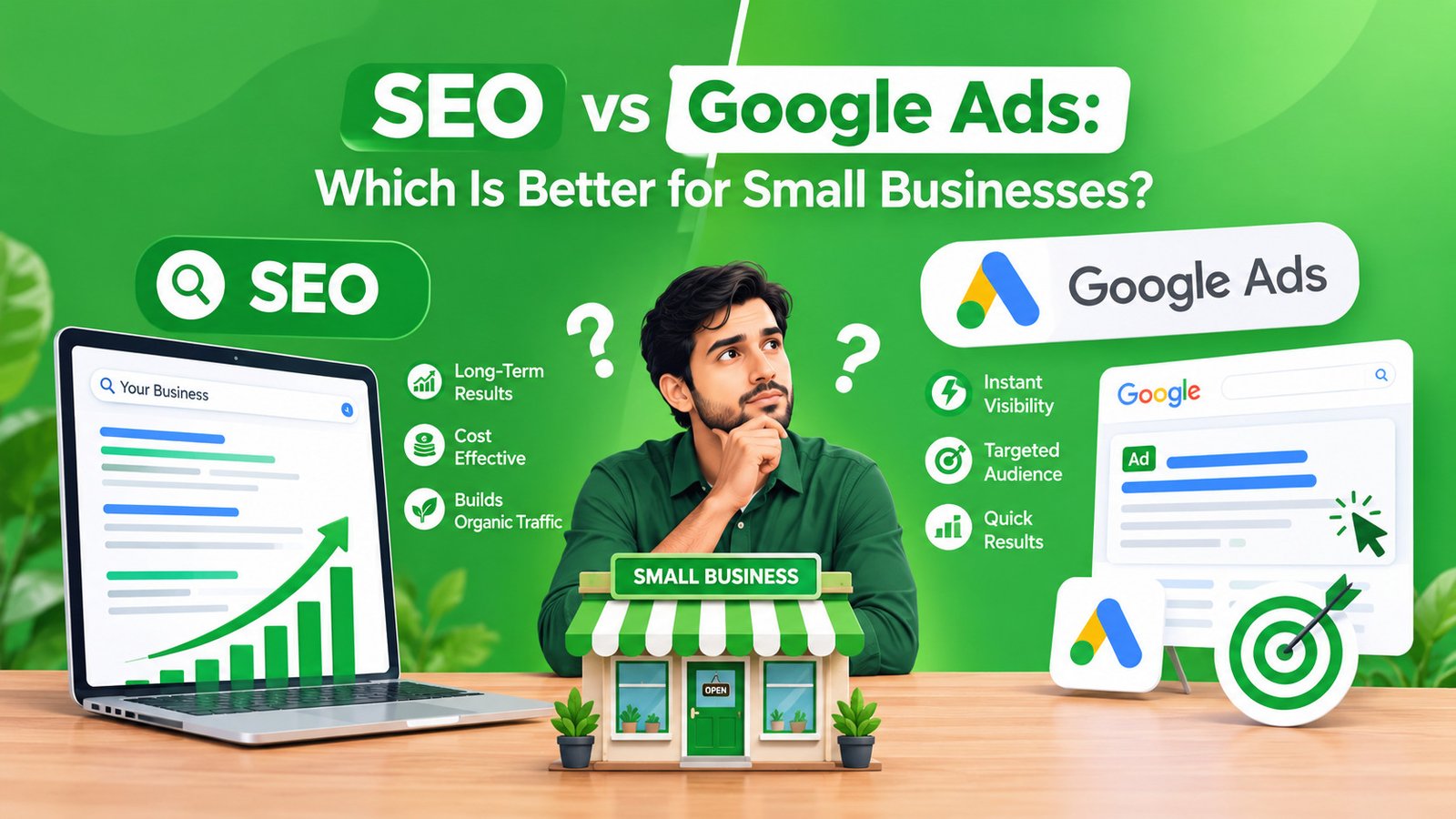
Small businesses often have limited marketing budgets, so choosing the right way to attract customers matters. Two of the most common options are SEO and Google Ads. Both can bring visitors from Google, but they work in very different ways. SEO focuses on improving your website and online presence so that your pages can earn organic visibility in search results. Google Ads, on the other hand, allows businesses to pay for advertising placements when people search for relevant products or services. So, which one is better for a small business?
The honest answer is: it depends on your goals, budget, competition, business model, and how quickly you need results. SEO can build long-term organic visibility, while Google Ads can help you reach potential customers much faster. For many businesses, using both strategically can be more effective than choosing only one. In this guide, we will compare SEO and Google Ads, explain their advantages and limitations, and help you decide where your marketing budget may be better spent.
What is SEO?
SEO, or Search Engine Optimization is the process of improving a website and its online presence so search engines can better understand its content and users can find it through relevant organic searches.
SEO can include several areas, such as:
- Keyword research
- Search intent optimization
- On-page SEO
- Technical SEO
- Content optimization
- Internal linking
- Local SEO
- Link building and digital PR
- Website performance
- Structured data
- Content and topical authority
If you are new to SEO, you can learn the fundamentals in the guide What Is SEO? How SEO Can Help Your Local Business Grow?
SEO does not mean paying Google every time someone clicks your organic result. Instead, the goal is to earn visibility through useful content, strong website structure, technical quality, relevance, and genuine authority. Google’s search systems evaluate many signals when determining which pages are relevant and useful for a particular query. Therefore, SEO is not simply about adding keywords to a page.
What Are Google Ads?
Google Ads is Google’s paid advertising platform. Businesses can create advertisements that may appear when people search for keywords related to their products or services. For Example, Imagine you own a local plumbing company.
Someone searches:
“emergency plumber near me”
If you are running a relevant Google Ads campaign, your advertisement may appear in a paid advertising position for that search.
With Google Ads, businesses can control several important parts of a campaign, including:
- Target keywords
- Geographic areas
- Advertising budget
- Ad messaging
- Landing pages
- Audience targeting
- Bidding strategies
- Conversion tracking
The exact cost of advertising varies considerably. Competitive industries and keywords can cost more than less competitive searches. This means Google Ads can generate results quickly, but the business needs to manage the advertising budget carefully.
SEO vs Google Ads: The Main Difference
The biggest difference is simple:
SEO earns organic visibility, while Google Ads buys advertising visibility.
When you invest in SEO, you are improving an asset that can continue attracting organic traffic after the initial work has been completed. With Google Ads, you generally pay for traffic generated through your advertising campaigns. When the campaign stops, the paid traffic generated by those ads can stop as well.
Here is a simple comparison:
| Factor | SEO | Google Ads |
|---|---|---|
| Traffic type | Organic | Paid |
| Speed | Usually slower | Usually faster |
| Long-term value | High potential | Depends on continued advertising |
| Cost model | SEO investment | Advertising spend |
| Immediate traffic | Usually limited | Possible |
| Brand authority | Can build over time | Mainly advertising visibility |
| Control | Less immediate control over rankings | More control over targeting and budget |
| Best for | Long-term growth | Immediate demand and testing |
Neither option is automatically better for every business. The right decision depends on what you are trying to achieve.
Benefits of SEO for Small Businesses
1. SEO Can Build Long-Term Organic Visibility
One of the biggest advantages of SEO is the potential to build sustainable organic visibility. When a useful page earns strong organic rankings, it can continue receiving visitors without paying for every individual click. However, this does not mean SEO is free. Businesses may need to invest in content, technical improvements, website development, SEO expertise, digital PR, link acquisition, and ongoing optimization. The difference is that SEO investment is focused on improving your website and organic search presence rather than directly purchasing each visit.
2. SEO Can Help Build Trust
People often use Google to research a business before making a purchase or contacting a company. A business that consistently appears for relevant informational, commercial, and local searches can build stronger visibility in its market. Useful content can also demonstrate experience and knowledge. For example, a roofing company could publish helpful resources about roof maintenance, repair costs, common roofing problems, and questions customers should ask before hiring a contractor. This approach can help potential customers understand the business before they contact it.
3. SEO Can Support Different Types of Searches
SEO can target more than one type of search. You can create content for:
- Informational searches
- Commercial investigation
- Local searches
- Product searches
- Service searches
- Comparison searches
- Transactional searches
For local businesses, What is Local SEO? Why Every Local Business Needs Local SEO? Explains how search visibility can be improved for location-based searches.
4. SEO Can Strengthen Your Website
A good SEO strategy is not limited to keywords. It can also identify technical and structural problems that affect both search engines and users. Technical SEO can address areas such as:
- Crawlability
- Indexing
- Mobile usability
- Website speed
- Internal links
- Site architecture
- Canonical URLs
- XML sitemaps
- Structured data
- Broken links
You can learn more in Technical SEO: A Complete Guide for Beginners. These improvements can benefit your overall website experience, not just your search rankings.
Limitations of SEO
SEO also has limitations, especially for small businesses that need immediate leads.
SEO Usually Takes Time
SEO is not normally an overnight marketing channel. The time required to see meaningful results depends on factors such as:
- Website condition
- Industry competition
- Existing authority
- Search demand
- Content quality
- Technical problems
- Target location
- Search intent
- Competitor strength
A new website in a competitive market may need considerably more time and investment than an established website targeting less competitive searches. There is also no legitimate way to guarantee a specific Google ranking. Google’s search results can change as competitors publish new content, search behavior changes, websites are updated, and Google’s systems evolve. For this reason, businesses should treat SEO as an ongoing process rather than a one-time project.
Benefits of Google Ads for Small Businesses
1. Google Ads Can Generate Traffic Quickly
One of the biggest advantages of Google Ads is speed. A business can create a campaign, select relevant targeting, set a budget, and potentially start receiving clicks once the campaign is approved and running. This can be particularly useful for businesses that:
- Have just launched
- Need leads quickly
- Are promoting a new service
- Are running a limited-time offer
- Want to test a market
- Are entering a competitive search market
For a new business, paid search can provide visibility while its organic SEO strategy is still developing.
2. You Can Test Keywords and Offers
Google Ads can also provide useful marketing data. For example, a business may test different:
- Keywords
- Headlines
- Offers
- Landing pages
- Calls to action
- Locations
The data from these campaigns can help a business understand what potential customers respond to. That information can also influence future SEO and content decisions.
3. Geographic Targeting Can Be Useful
Local businesses can use paid search campaigns to target specific geographic markets. For example, a business serving customers in Dhaka may want its advertising campaign to focus on relevant areas instead of paying for clicks from people outside its service area. However, geographic targeting should still be planned carefully because the right settings depend on the business, service area, and campaign objective.
Limitations of Google Ads
1. Advertising Requires an Ongoing Budget
Google Ads can generate traffic while a campaign is active, but advertising requires continued spending. If a business stops its campaign, the paid traffic generated through that campaign may stop as well. This makes budgeting and return-on-investment tracking especially important.
2. Clicks Do Not Guarantee Customers
A paid click is not the same as a sale or qualified lead. Your results depend on several factors, including:
- Keyword selection
- Search intent
- Ad quality
- Landing page experience
- Pricing
- Offer
- Competition
- Conversion process
- Tracking accuracy
A campaign can receive clicks and still perform poorly if the landing page does not match what the visitor expected.
3. Competitive Keywords Can Be Expensive
Some industries have strong competition for commercial search terms. If many businesses are competing for the same searches, advertising costs can increase. This is why small businesses should not simply increase their budget without understanding which keywords, locations, and conversions are producing profitable results.
SEO vs Google Ads: Which Is Cheaper?
There is no universal answer. SEO can require significant upfront investment, particularly if a website needs technical improvements, new content, better service pages, digital PR, or authority building. Google Ads requires direct advertising spend and may produce traffic quickly, but the business must continue spending to maintain that paid traffic.
The better question is not:
“Which one is cheaper?”
Instead, ask:
“Which channel can generate profitable customers for my business at an acceptable cost?”
For example, a business may be comfortable paying more for a qualified lead if that lead has a high lifetime value. A low-cost click is not necessarily valuable if it never becomes a customer.
Should a Small Business Choose SEO or Google Ads?
Consider your business situation.
Choose SEO When:
SEO may be a strong choice if:
- You want long-term organic growth
- Your customers regularly use Google to research your services
- You have time to build organic visibility
- You want to create a long-term search asset
- Your website has valuable content opportunities
- You want to strengthen brand authority
- You want to reduce dependence on paid traffic over time
Consider Google Ads When:
Google Ads may make sense if:
- You need traffic quickly
- You have a new website
- You have a strong commercial offer
- You want to test demand
- You need leads immediately
- You can track conversions properly
- You have a clear advertising budget
Consider Both When:
For many small businesses, the strongest approach may be to use both. Google Ads can help capture immediate demand while SEO builds organic visibility for the future.
For example:
Google Ads → Immediate visibility
SEO → Long-term organic visibility
Conversion optimization → Turn visitors into leads or customers
Analytics → Measure what is actually working
This creates a more balanced digital marketing strategy.
SEO and Google Ads Can Work Together
SEO and Google Ads should not always be treated as competing marketing channels. They can support each other. Suppose you run Google Ads for a service and discover that a particular search term generates qualified leads. That information can help you identify valuable topics and commercial search terms for your SEO strategy. At the same time, organic search data can help you understand which topics, services, and questions your audience cares about.
A combined strategy could look like this:
- Use Google Ads to generate immediate visibility.
- Track clicks, leads, sales, and conversion rates.
- Identify valuable search terms and customer questions.
- Create or improve organic landing pages.
- Build supporting educational content.
- Strengthen internal linking between related pages.
- Improve technical SEO and website experience.
- Continue measuring organic and paid performance.
This approach allows your paid and organic marketing activities to inform each other.
What About Local Businesses?
For local businesses, the decision can be even more important.
A customer may search for:
“SEO expert near me”
“plumber in Dhaka”
“best restaurant in Khulna”
“dentist near me”
These searches can have strong local intent. A local business should consider its Google Business Profile, website, local landing pages, reviews, local content, citations, and organic visibility alongside paid advertising. If your business depends heavily on customers from a specific geographic area, building a strong Local SEO strategy can be an important part of long-term visibility. Paid advertising can then be used strategically when immediate visibility or additional lead volume is needed.
What About eCommerce Businesses?
eCommerce businesses may also benefit from combining SEO and Google Ads. Organic SEO can help product and category pages attract people who are researching or ready to purchase. Paid advertising can help promote products quickly and test demand.
A strong eCommerce SEO strategy should consider:
- Product pages
- Category pages
- Search intent
- Product descriptions
- Internal linking
- Site architecture
- Technical SEO
- Helpful buying content
The right mix depends on product margins, competition, customer lifetime value, seasonality, and advertising performance.
How Much Should a Small Business Spend on SEO and Google Ads?
There is no single budget that works for every small business. Instead of choosing a budget based only on what competitors spend, start with your business economics.
Consider:
- Average customer value
- Profit margin
- Customer lifetime value
- Lead-to-customer conversion rate
- Average cost per lead
- Average cost per acquisition
- Available marketing budget
- Search demand
- Competition
- Business growth goals
For Google Ads, conversion tracking is especially important. You need to know whether your advertising spend is generating meaningful business outcomes rather than simply clicks.
For SEO, measure progress through organic impressions, rankings, qualified traffic, leads, conversions, and revenue where reliable tracking is available.
How to Measure SEO Success
SEO should not be judged only by keyword rankings.
Useful performance indicators can include:
- Organic impressions
- Organic clicks
- Qualified organic traffic
- Search visibility
- Keyword growth
- Leads
- Sales
- Conversion rate
- Revenue
- Local visibility
- Engagement with important pages
Google Search Console and website analytics can help businesses understand how organic search performance changes over time. A ranking increase is useful, but the ultimate goal should be connecting your website with the right audience and generating meaningful business outcomes.
How to Measure Google Ads Success
For Google Ads, businesses should also look beyond clicks.
Important metrics can include:
- Ad spend
- Clicks
- Cost per click
- Conversions
- Conversion rate
- Cost per conversion
- Qualified leads
- Sales
- Revenue
- Return on ad spend
A campaign that produces 100 clicks is not necessarily better than a campaign that produces 30 clicks if those 30 visitors are more likely to become customers.
The quality of traffic matters.
SEO vs Google Ads: The Final Verdict
So, SEO vs Google Ads: which is better for small businesses? There is no universal winner. SEO is generally better for businesses focused on long-term organic visibility, authority, and sustainable search growth. Google Ads can be better for businesses that need immediate visibility, fast traffic, market testing, or short-term lead generation. For many small businesses, the best solution is not choosing one and ignoring the other. A practical strategy may be to use Google Ads for immediate opportunities while building SEO as a long-term growth channel. The most important part is measuring business outcomes. Do not invest in SEO simply because everyone says you need SEO. Do not spend more on Google Ads simply because it generates clicks quickly.
Instead, understand your customers, search intent, competition, conversion process, and business economics. Then invest in the channels that are most likely to produce qualified customers.
Final Thoughts
SEO and Google Ads serve different purposes, but both can play an important role in a small business marketing strategy. SEO can help build organic visibility, useful content, website authority, and long-term search presence. Google Ads can provide faster access to relevant searches when you have a well-planned campaign and sufficient budget. The strongest strategy is usually based on your actual business situation rather than a one-size-fits-all formula. If your website needs stronger organic visibility, technical improvements, Local SEO, eCommerce SEO, or a more structured search strategy, working with an experienced SEO professional can help you identify the opportunities and prioritize the work based on your goals.